Earn the right to be recognised
Strip your logo from everything you've distributed across your marketing channels in the last three months. No name, no logo. Just the words, the tone, the point of view. Could someone still tell it was created by you? For most brands, the honest answer is no.
By Rachel Lyndon-Jones · 2026-06-03 · 6 min read
Today, more content is generated by AI than by people, but it's mostly average… big surprise. People are developing sharp instincts for what's original, actively scrolling and searching for content that feels real, and moving away from spaces that aren’t overrun with AI; booktok, goodreads, newsletters, podcasts, YouTube. 61% of marketers agree that having a clear brand point of view is now more important than ever. Distinctiveness has become the most valuable asset a brand can have, and it's what separates the brands people feel something about from the brands that simply exist in their peripheral vision.
You know where
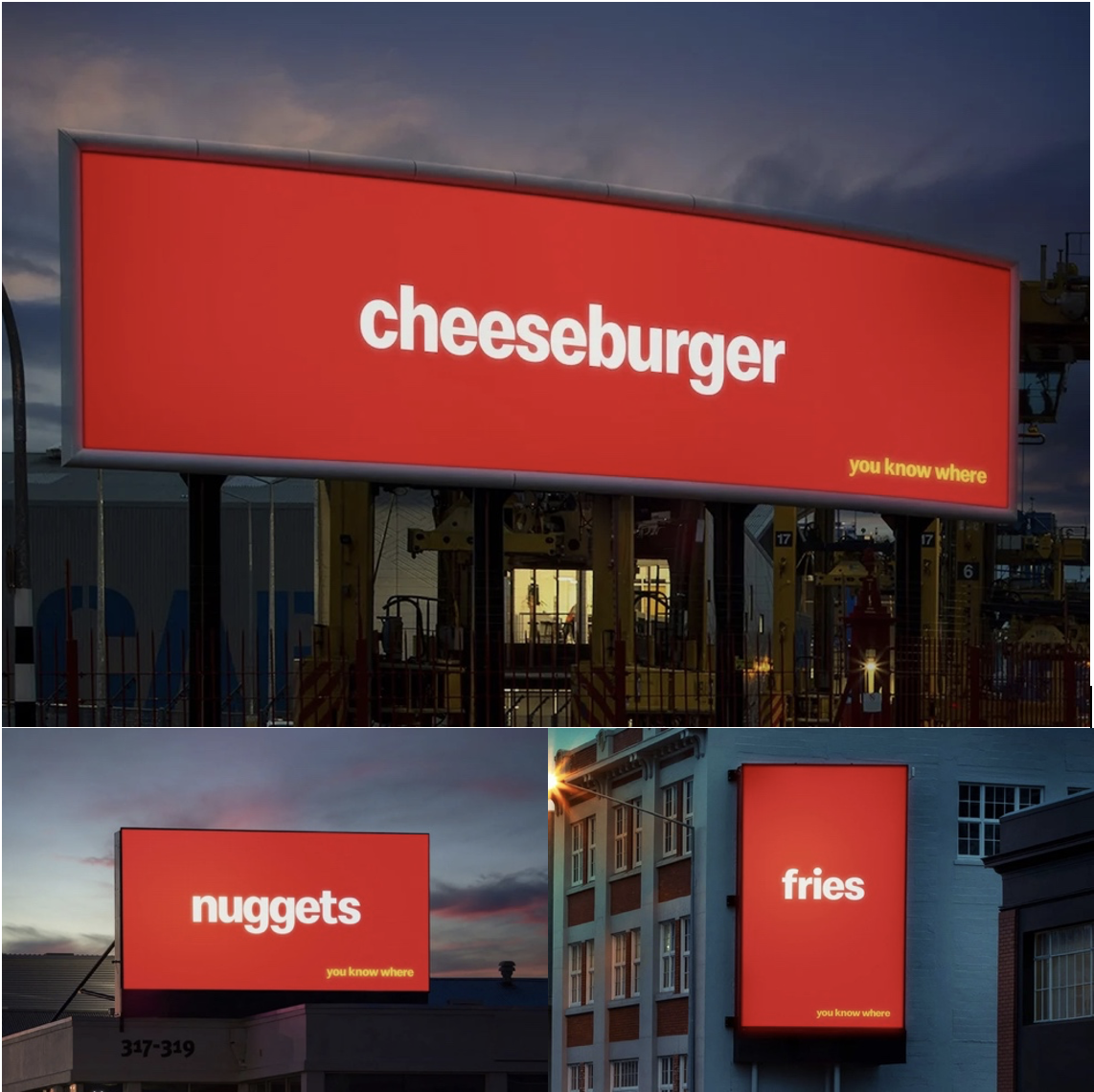
In February 2026, McDonald's New Zealand ran an outdoor campaign that stopped the industry in its tracks, not because it was loud or extravagant, but because it was almost nothing at all.
No Golden Arches, no logo, no product photography, no tagline. Just the names of iconic menu items, cheeseburger, fries, apple pie, in large white typography on a red background, with a single small line in the corner, 'You know where'.
That's it. That's the entire ad.
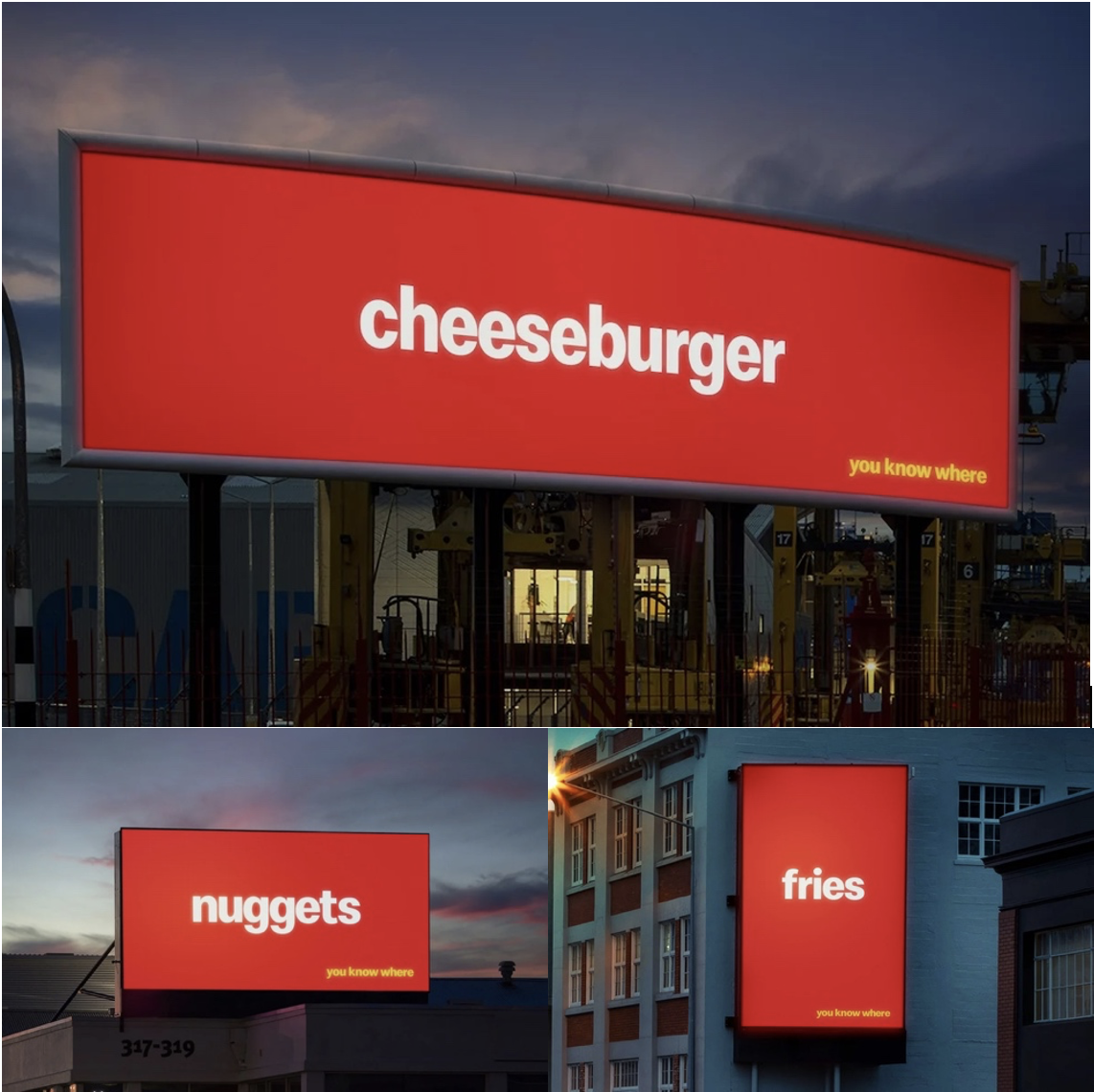 Created by McCann New Zealand, 'You know where' is one of the most elegant demonstrations of earned brand distinctiveness I've seen this year. As McCann's chief creative officer Gary Steele put it "Macca's is an iconic global brand, and their products are so iconic they need no explanation, so we let the words do the talking." Leigh Benvie, head of brand and media at McDonald's New Zealand, agreed "There aren't many brands that could pull that off and confidently trust people to instantly connect the dots. That's the kind of brand power Macca's has."
The reason it works, the reason it can work, is not a clever campaign idea. It's decades of consistent, patient brand-building that has embedded the brand into cultural memory. The campaign didn't create recognition. It revealed recognition that was already there, from showing up the same way, in the same colours, with the same products, in the same moments of people's lives, for over eighty years.
The ad is the proof. The brand is the work that made the proof possible.
So I ask a direct question to every other brand... what have you built that is so distinctively, recognisably yours that you could strip everything back and still be known?
Recognition
McDonald's didn't arrive at 'You know where' by posting constantly or rigorously following their content calendar. They got there because the brand's identity, its colours, its products, its place in people's routines, has been applied with near-obsessive consistency across every touchpoint for decades.
This is what Byron Sharp's How Brands Grow calls mental availability: the ability to be thought of instinctively in buying situations, without prompting. Research aligned with Sharp's work suggests mental availability accounts for roughly 60–70% of the variance in market share between brands of similar size. Binet and Field's The Long and the Short of It agrees, stating that brands that sacrifice long-term brand building for short-term tactics systematically underperform over time. (I delve further into this in my piece on the psychology of growth)
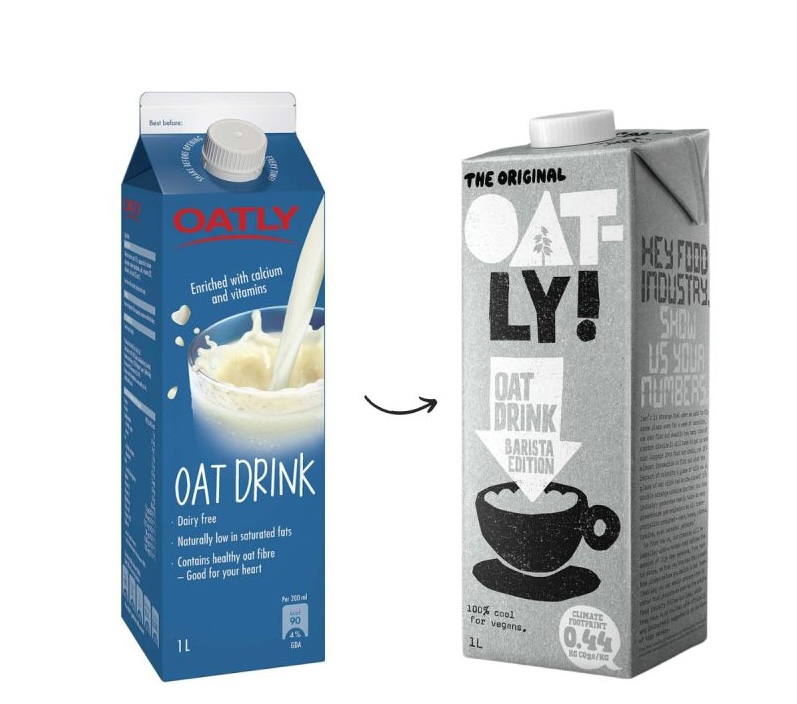 Oatly is a more recent example of the same principle. They didn't have eighty years under their belt. What they had was a complete knowing of who they were and what they stood for from the moment they rebranded in 2014/15; provocative, self-aware, funny in a way that felt entirely unlike anything else in the food and drink aisle. Their packaging reads like a stream of consciousness. Their outdoor advertising asks uncomfortable questions about the dairy industry. Their social media sounds like a person, not a brand. Whether you encounter Oatly on a supermarket shelf, a billboard, or an Instagram post, the imprint is immediate and unmistakable. You don't need the logo to know who's talking.
Innocent Drinks has operated the same way since 1999. Their voice is playful, warm and just slightly absurd, and it travels from their bottle caps and knitted hats to their annual reports to their social media. The feel of Innocent is consistent enough that their tone of voice functions as a visual identity in its own right. You could read a line of their copy with the branding removed and still recognise it immediately.
What connects McDonald's, Oatly, and Innocent is not sector, or budget, or scale. It's that each of them made a decision, consciously or culturally, about who they were, and then never stopped being that thing.
Even a disco ball can't always sparkle
Spotify handed us the perfect example just this month.
 They temporarily replaced their iconic green app icon with a shimmering disco ball to mark their 20th anniversary, and everyone lost their shit. The backlash was instant. Users called it hideous, pixelated, and said it looked like a stalled download. Spotify responded with exactly the kind of voice a brand should have in a crisis “Alright, we know glitter is not for everyone. Our temp glow up ends soon. Your regularly scheduled Spotify icon returns next week.”
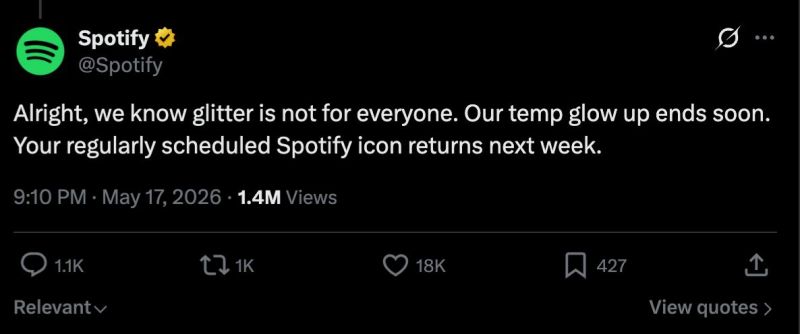 Self-aware. Calm. Completely on brand. No damage-control language. No lengthy statement. Just the brand, sounding like itself.
But the real story isn't the somewhat questionable logo. It's what the reaction proved. Spotify's green circle has become so embedded in people's daily routines, on home screens, opened dozens of times a day, that even a temporary logo felt like a violation of something personal. People weren't angry about a design change. They were protective of something that had become theirs.
That's not brand recognition. That's brand ownership. And it doesn't come from copying content from AI. It accrues over twenty years of showing up consistently, sounding like yourself.
Everything sounds the same
Most brands know what they want to sound like, they just don't sound like it, consistently, across every touchpoint, over a long enough period of time for it to turn into anything meaningful.
A 2026 brand voice study found that 60% of marketing materials fail to conform to brand guidelines, and 81% of companies struggle with off-brand content despite having documented guidelines.
AI has made this worse. The logos look right, but the words sound generic. Visual brand consistency holds up while verbal and tone consistency collapses.
The brands that are building real distinctiveness right now are not necessarily the ones producing the most content. They're the ones where every single piece of output, from a billboard to a social comment to an email footer, feels like it came from the same mind.
What this means for brands
The 'You know where' test is a useful place to start. Start with your strategy. Strip your brand back to its most minimal form and ask whether people would still find you. If the answer is anything other than a resounding 'yes', the question to work backwards from is - what is the one thing only you would say, in the one way only you would say it?
This isn't about writing a new set of brand guidelines or creating another tone of voice document, though those things can help. It's about making a clear decision about what your brand stands for, one repeatable way of seeing the world, and then applying it with consistency and patience across your entire marketing mix.
Consistency, over time, becomes a signal. In noisy feeds, the brand that feels the same every single time you encounter it starts to feel like something you can rely on.
McDonald's New Zealand didn't need to say their name. They'd already said it a million times in a million places over eighty years.
That's the work. It's slower than a campaign. It's harder to measure than reach, and it's the only thing that actually compounds.
Rachel Lyndon-Jones is Co-Founder and CMO of Ouma, a strategic growth partner helping ambitious UK businesses build connected growth systems. Rachel's work sits at the intersection of marketing psychology, brand trust and commercial strategy, helping businesses understand not just what to do, but why it works.
Summary
This article explores how brands build genuine distinctiveness — the kind that makes them identifiable without a logo, tagline, or visual cue. Using McDonald's New Zealand's 2026 "You Know Where" OOH campaign as the central case study, it argues that brand recognition at this level is not the product of content volume or clever campaigns, but of consistent identity applied patiently across every touchpoint over time. Supporting examples include Spotify's 20th anniversary disco ball backlash, Oatly's irreverent tone of voice, and Innocent Drinks' tonal consistency across platforms. The piece draws on Byron Sharp's mental availability research and a 2026 brand voice consistency study showing 81% of companies struggle to maintain on-brand content at scale. The central argument: in an era of AI-generated content and audience scepticism, a clear and consistent point of view is the most valuable, and most underinvested, asset a brand can hold.
Key takeaways
- Recognition is earned, not manufactured. Brand distinctiveness isn't the result of a clever campaign. It's the compound interest of consistent identity applied across every touchpoint over years. McDonald's New Zealand could run an ad with no logo because they'd already said their name a million times in a million places.
- The logo-strip test matters. Remove all visual branding from your last three months of content. Could someone still identify you from the words, tone, and point of view alone? For most brands, the honest answer is no, and that's not a creative problem. It's a strategic one.
- Mental availability drives market share, not content volume. Byron Sharp's research shows that being instinctively thought of in buying situations accounts for up to 70% of market share variance between similar brands. That level of recall isn't built by posting consistently. It's built by meaning something, consistently, over time.
- Tone of voice is a commercial asset, not a creative preference. Innocent Drinks' voice travels intact from their bottle caps to their social media. Oatly's packaging reads like a person, not a brand. Both are immediately identifiable without a logo. In a world where 81% of companies struggle to maintain on-brand content at scale, tonal consistency has become a genuine differentiator.
- Brand ownership is the goal, not brand recognition. When Spotify temporarily changed their app icon, users didn't just notice — they felt protective. That's not recognition. That's ownership. It happens when a brand becomes so embedded in people's daily lives that any change feels like a violation of something personal. It accrues over years of showing up the same way.
FAQs
- What does it mean for a brand to be recognisable without its logo?
It means your brand's tone of voice, colour, language, and point of view are consistent and distinctive enough that audiences can identify you from content alone — without any visual branding present. McDonald's New Zealand demonstrated this in February 2026 when their "You Know Where" campaign ran national billboards featuring only product names — no logo, no Golden Arches, no imagery — and every viewer knew instantly who was talking. It's the result of decades of consistent identity, not a single campaign. - How do brands build this kind of recognition?
Through consistency applied over time across every touchpoint — not just visual identity, but tone of voice, values, and the way a brand frames the world. Research from Byron Sharp's How Brands Grow shows that mental availability — being instinctively thought of in buying situations — accounts for roughly 60–70% of market share variance between brands of similar size. That level of recognition doesn't come from campaigns. It compounds quietly through repetition, coherence, and patience. - Why is brand consistency more important now than it was five years ago?
Because AI has made content faster and cheaper to produce, which has flooded every channel with generic, undifferentiated output. A 2026 brand voice study found that 81% of companies struggle to maintain on-brand content at scale, and visual consistency holds up far better than verbal and tonal consistency. In that environment, the brands that sound and feel the same every time they show up become exponentially easier to remember and trust. Distinctiveness has become scarce — which makes it more valuable. - Does this only apply to large, established brands?
No. McDonald's and Spotify have scale that most brands don't, but the principle operates at every level. Oatly built unmistakable brand identity from a niche challenger position within a few years of rebranding in 2012, purely through tonal commitment and consistency. The question isn't how big you are — it's how clear and disciplined you are about who you are and how you show up. Smaller brands arguably have an advantage here: they can move faster, sound more human, and make bolder creative decisions without layers of approval. - What's the difference between brand consistency and just being repetitive?
Consistency means your core identity — your values, perspective, and voice — stays recognisable across every piece of content and every platform. Repetition means saying the same thing over and over without variation or relevance. The brands that get this right, like Innocent Drinks, adapt their tone to platform and context without ever losing their essential character. The voice stays fixed; the expression of it stays fresh. Repetition bores people. Consistency builds trust. - How do I know if my brand has a strong enough identity to carry this kind of recognition?
Try the logo-strip test: remove all visual branding from your last ten pieces of content and ask whether someone who knows your brand could still identify them as yours. Then ask whether someone who doesn't know your brand could identify a consistent personality or point of view across them. If the answer to either question is uncertain, the work isn't on your content output — it's on clarifying what your brand actually stands for, and building the operational systems to express that consistently across every channel, at scale.